Shabel Enterprises
Accelerating Electronic Health Record Integration
Healthcare Organization
Context. A healthcare organization worked extensively with Electronic Health Records and needed to integrate and consume that data faster and more reliably. EHR data is unusually demanding: it is high-volume, arrives in many formats from many sources — including standardized healthcare forms — and changes shape as new features and feeds are added. The organization's existing methods made onboarding new data slow and brittle, and in a clinical context, "slow and brittle" carries real consequences. The work was to design an integration foundation that was fast to deliver, safe to run, and — crucially — modular enough that the client's own team could build on, maintain, and extend it as their needs evolved, rather than depending on bespoke, one-off builds.
The Stakes. Healthcare data is unforgiving. An integration that silently drops or corrupts records is worse than no integration at all — so fault tolerance, operator alerts, and data-quality enforcement are not enhancements here; they are the difference between a feed that clinicians and administrators trust and one they don't. Speed matters too, but never at the expense of correctness.
The Challenge. Design a foundation to enhance and accelerate the integration and consumption of EHR data, build in data quality and robust error handling, and make it modular enough for the client's team to implement, maintain, and grow.
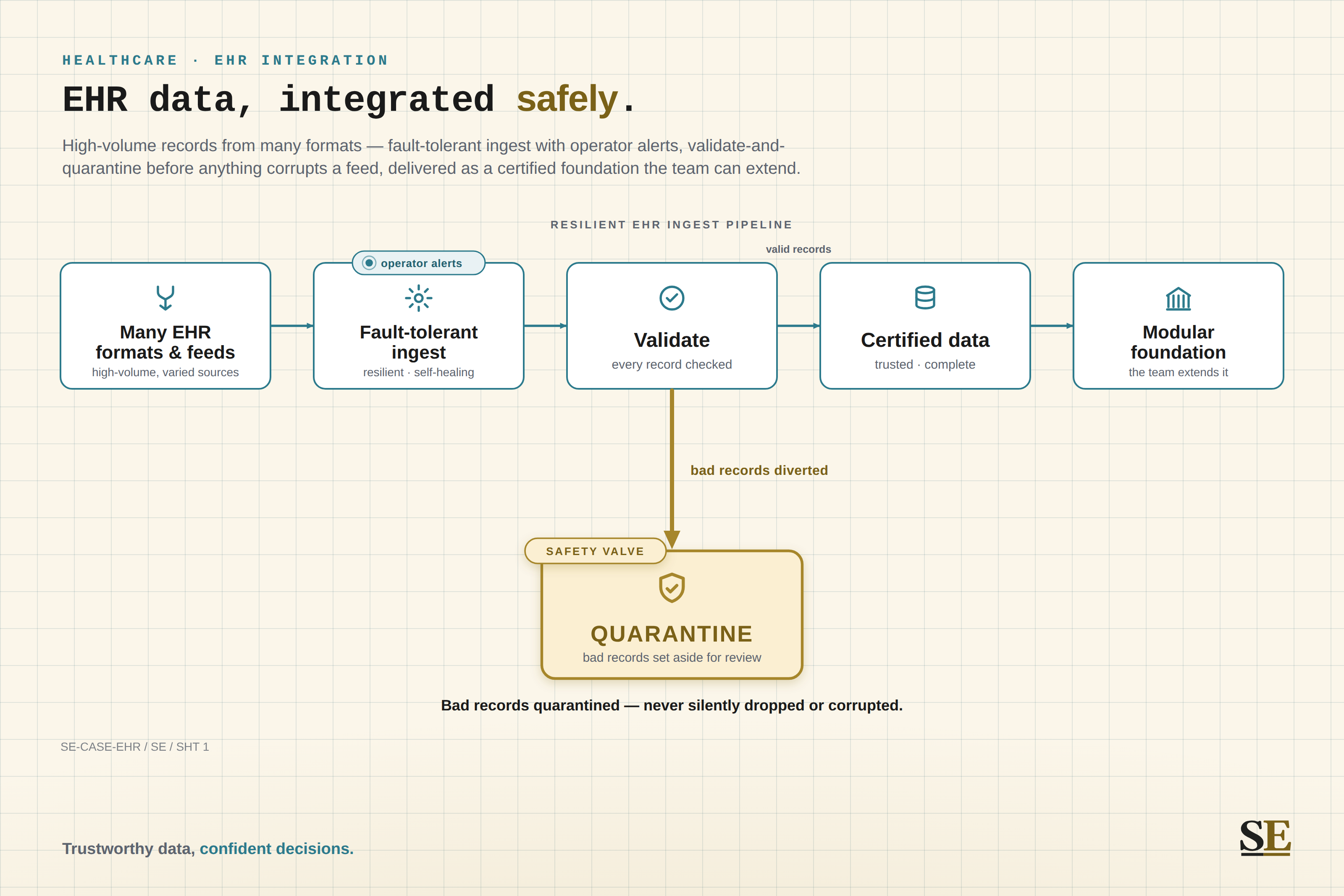
Our Approach.
- Designed for speed and maintenance. We designed a modular technical foundation — standardized ETL patterns and reusable build templates — for rapid delivery and low-friction maintenance as the data landscape kept changing.
- Templated the repetitive work. We built a SQL schema-generation templating approach to ease integration of new features, and a standard merge stored-procedure template engineered to sharply cut the time to build dimensional-update procedures.
- Designed for fault tolerance. We specified fault-tolerant multi-file incremental import/export with error handling and operator alerts, so failures would surface loudly instead of corrupting silently.
- Built quality into the design. We integrated a data-quality methodology into every import path, using a spreadsheet-driven pre-processor to generate dynamic data-conformity rules.
- Set the team up to build. We developed the parsing and consumption approach for the EHR information, and documented the standardized ETL processing, estimation, and data flow — so the client's own team could implement, prototype, and carry it forward.
What Was Delivered. A complete, modular technical design for faster, more reliable EHR integration — with data quality and fault tolerance built in from the start rather than bolted on afterward.
Metadata drives delivery. The metadata-driven design was built to make onboarding new feeds and features dramatically faster, to enforce data-quality rules on every import so out-of-specification records are caught before they load, and to turn silent data-loss into loud, recoverable failures — engineered for speed and safety, and handed to the client's own team to implement and prove out.
What It Demonstrates. Designing a modular, quality-first EHR integration foundation that is fast to extend and safe to run — the kind of careful, fault-tolerant architecture that healthcare data demands, delivered as a design the client's own team could build on and carry forward.
Capabilities. EHR integration · healthcare data · data-quality methodology · fault-tolerant ETL design · schema & merge templating · technical design & documentation · team enablement.
← All Case Studies · ← Previous: Standardizing Enterprise Data Integration in Financial Services · Next: Building Our Own Governed Web Platform
Work With Us
Designing an integration foundation that has to be right the first time? Let’s talk.
Contact Us →